Thursday, November 10, 2011

Mulberry Stoker Inset Stove

.


A First Look at 
The Mulberry Stoker
Inset Stove

INTRO

I had a long and very interesting conversation recently with Peter Hughes of Mulberry Stoves Ireland. Peter really knows his stuff and answered my many questions regarding the design principles, operation, materials, installation, efficiency, fuel, and maintenance of solid fuel inset stoves.

Why am I telling you this? The reason I mention it is because it gives me confidence to know that there is an individual in a company who is a competent engineer, and who fully understands the scientific design and operating principles involved in their subject.

The Stoker Inset

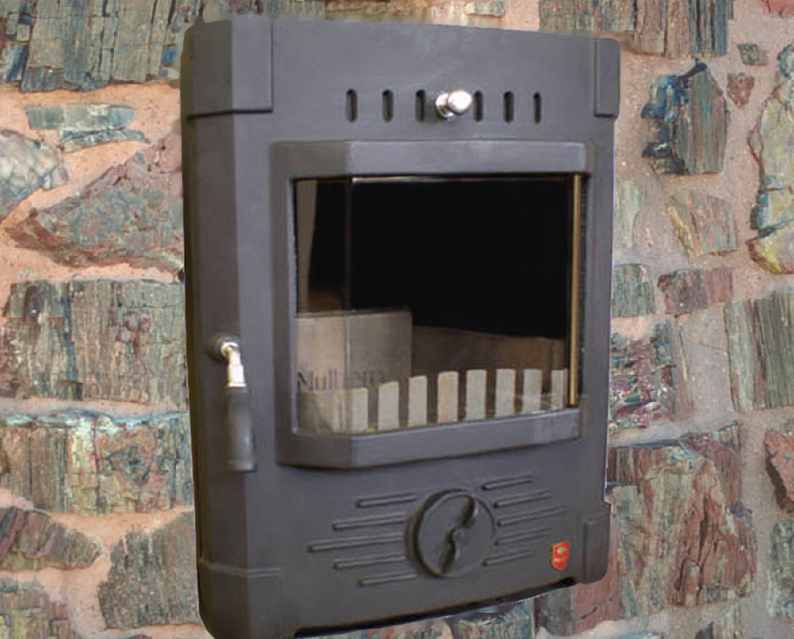
The Mulberry Stoker is a bit different in its basic shape from the many run of the mill inset stoves on the market. It presents an unfussy look with modern simple clean lines.

I am looking here, in this posting, at the non-boiler version of the Mulberry Stoker. There is also a stove available with a built-in boiler.

One very different feature of the Stoker is the fire box, which appears to project outwards into the room in a unique "Bay Window" formation. This feature allows a very wide angle view of the fire, but it also presents a larger surface area to the room thus allowing more heat to radiate and convect to the room space.

This would appear to be reflected in the higher rated output of 6.5kW. A figure of between 5 and 6kW is about average. The Mulberry also has a notably higher efficiency of 76%. A certified efficiency of 76% is unusual in an inset stove. Efficiency of 70% would be considered good, 76% is closer to the efficiency of a free standing stove and is excellent for an inset.

Note the Dormer fronted Fire box
 
Castings

All of the castings which come into contact with the fire, such as grates, baffles etc., are done in 17%.hi-chrome iron. This makes them resistant to burning out and therefore longer lasting.


The Convection Airflow Pattern

Price

The Stoker inset is a bit more expensive than the Blacksmith Anvil. The list price is just over €1000 but it can be purchased a deal cheaper than this. Walsh Bros. Tullamore currently have it on a special offer at €795.


http://www.superstore.ie/product-eng-1434-Mulberry-Stoker-Inset-Non-Boiler-Stove-6-5kw.html


Manufacturer Specifications


• Maximum output 6.5kW
• Maximum fuel consumption 0.93kg per hour
• Efficiency of 76%
• Clean burning with low emissions - O.26% CO (at 13% O2)
• Long lasting 17% Hi-Chrome castings in grate and firebox
• Unique bay window gives wide view of fire
• Window air wash for clean glass
• Provides both Convection and Radiant heat
• Will burn overnight
• Easily installed – DIY fitting in 15 minutes
• Works perfectly in normal chimney
• Can be used with or without flexible flue liner
• Guaranteed Irish – manufactured in Ireland
• Certified to EN 13240 and CE approved
• Manufactured by company certified to ISO 9001
and ISO 14001

I have not had a chance to see this stove working as yet, so I can give no assessment of its actual performance. When I get to examine one close up I will inform the blog with an update.


.

Wednesday, November 09, 2011

Economic and Social Order Sustainability

.


No one will deny that there is a multi-faceted world-wide crisis happening. The financial situation is generally the focus of blame. However I believe it is far deeper than mere economic problems.

Belief, trust, a positive outlook, and a willingness to co-operate and share are, IMHO, at the very core of the problems.

Politicians and bankers head the list of the least trusted people on the planet. Yet, they are the ones controlling the situation. What does that tell you? Jungle laws apply - the big and the powerful take it all and only the scraps are fought over by the rest.

In Ireland, it seems that when things get tough and the people lose hope - the Irish get pissed. Reports just out indicate that there has been a 42% increase in alcohol and substance abuse in just 5 years since the last figures in 2005.

That is just frightening, especially when the fall-out implication are considered. Family life and children will take the biggest hit, leading to increased social problems in the future. But the Irish economy will also suffer through lost work days and increased medical and social service requirements. And of course the Irish reputation as a nation of drunks will suffer yet further.

What is this post about? I am just airing my ruminations and worries for the immediate future.  Interesting, highly volatile, and scary times we are living in!!


.

Saturday, November 05, 2011

Inset Stove Design and Some Tests Part 3

.


SPECIFIC SIMPLE TEST 
FOR CONVECTION 
IN AN INSET STOVE

Here is a very basic but effective test to show if you are getting a proper outward and upward flow of convection hot air. It involves nothing more than a strip of lightweight tissue paper placed across the length of the convection grill.

The Basis of the Test

Think about this for a moment - if you were to place a narrow strip of lightweight tissue paper across the top of just about any operating convector heater, what would you expect might happen to the tissue?

(a) Would it be wafted upward by a current of hot air?
(b) Or, would it be sucked down onto the top of the heater?

Think “hot air balloon”  - think why does smoke go up a chimney.

So on an inset stove you will find a grill or grills at the very top of the stove above the glass door. The grill is the convection grill.

IF THE STOVE IS OPERATING CORRECTLY there will be an outflow of hot air from this top grill.

FACT: Most of the heat from an inset stove has to come by way of the convection system. If the convection system is not operating properly, the stove efficiency will be severely reduced. If the convection system is completely dysfunctional, the stove may be some 60% less efficient than it should be.

TO TEST


CAUTION: Before attempting any tests you should be fully satisfied that there is no danger of an accident occurring. If you don't feel confident - then don't do the test.

A piece of lightweight tissue paper about 35 x 7cm is simply gently placed on top of the grill/s for a few seconds. If there is any reasonable convection process taking place, the tissue paper will be wafted upwards - maybe not a lot -  but there should be some lifting of the tissue.

If it is not being wafted upwards in the hot airflow - or indeed if the opposite happens to be the case - and it is being sucked down onto the grill, you have a problem.

TWO POSSIBLE PROBLEMS


1.    No upward current of hot air = no convection taking place. This could be a blockage in the convection channels - or it might be bad design.
2.    The tissue being sucked down onto the grill = a negative air current which mean not only do you NOT have convection, BUT ALSO any heat in the convection chamber is being vacuumed up the chimney. You have a faulty inset stove. This could be a cracked stove or it could be bad design causing this to happen.


HOW ABOUT THE BLACKSMITH ARTISAN?

The number (2) of the above problems is what is happening with a Blacksmith "Artisan" stove I have encountered. I am wondering if this is a singular problem, or are there perhaps other Artisan owners out there who might be experiencing the same problem?

If you own a Blacksmith Artisan, I would like to hear from you how well you find the convection system operating.

Q1 - Do you get a good blast of hot air from the top grill?
Q2 - Or if you decide to do the tissue test - did you find the tissue being sucked down onto the grill?


.

Wednesday, November 02, 2011

Saving on Winter Fuels Smokeless Coal

.


 Calco Smokeless Coal


Smokeless Coal
at a really GOOD price

I have decided this winter to hold off on buying Heating Oil because the price is just horrific - 20% dearer that up the North - due to Irish taxes.

Instead, I am using smokeless coal in my stove and in my back boiler and fire door fireplace. So far, I am very pleased with the results.

Bord na Mona is charging €18.50 per 40Kg bag for the "Cozy Glow" smokeless. This is a good quality non-flame type of smokeless "briquette" type coal, but the price is very high indeed.

So I went on the hunt for an alternative and I eventually found a coal that works well in my stove and modified fireplace. The supplier I found is in Tralee. This smokeless coal is almost 25% cheaper than the Bord na Mona coal and it gives me results just about as good as the Cozyglo.

I have kept my fire burning overnight and the house toasty warm on this coal. The coal burns really well in stoves and is not too difficult to light. It is called Calco Smokeless and is a mixture of briquettes and nuggets. (see the photo above taken in my back yard)

If you buy three bags or more at a time you will get it for just €14 per 40Kg bag. So are you are asking me where is this bargain to be had??

The small privately owned business is located in Tralee. They will deliver in the Tralee area free of charge. If you are outside the town you will have to collect. I am all for small enterprises and therefore very happy to give these guys a go.

Here are the contact details.

Econ Fuels
Monavalley Industrial Estate
(just off the "Fat Mile" and
opposite DPL builders suppliers)
Tralee
086-8320050
066-4011099


.

Monday, October 31, 2011

Inset Stove Design and Testing Part 2

.


Insert Stove
Design Factors and Testing
Part 2

An Inset Stove called Firewarm


So to recap -

STANDARD TYPE STOVE:

A standard stove is simply a single sealed box. It can be made of iron - steel  -or other fireproof material.  Let us simply call this:
 

BOX ONE.

A controllable amount of air comes in one end to feed oxygen to the fire - and hot gasses and smoke goes out the other end and up the chimney. The heat from the fire is dispersed both by radiant and convection means from all sides of the stove.


INSET STOVE:

An Inset or Insert stove, by contrast,  is stuck into the wall or chimney breast and therefore it cannot radiate or convect heat - except from the front. That leaves 5 other surfaces which cannot give out any heat

An Inset Stove has TWO BOXES,  one inside the other. The inside box is a complete stove in and by itself.

The outer box is there for ONE PURPOSE ONLY. It is there to create convection air channels to take the heat from the sides, back, and top of the fire box, and GET THAT HEAT OUT INTO THE ROOM. This box let us call it:
   
BOX TWO.


BASIC TESTS FOR INSET STOVES

Apart from getting the fire to burn well and fully controllably in BOX NUMBER ONE, an inset stove needs to have a convection air current established in BOX NUMBER TWO (the outer box, in order to take the heat from the back -sides and top of the stove out and into the room.


TEST NUMBER ONE


What we are testing:

Is the burn rate of the fire fully controllable? This is a basic test for any type of solid fuel stove.

This test is really easy to establish. When the fire is fully lighted and burning really hot, simply turn down both the primary and secondary air controls fully.

The fire should immediately begin to dim down and within five minutes or so should be burning a dim red. After an hour or so - if the stove is in very good airtight condition, the fire should go out completely.

Most stoves are not completely airtight - so the fire may not completely die down but may continue to burn. However, it should only burn at a really very low rate!!

If it continues to burn at a faster rate, you have a faulty stove. The problem could be one of several things. Here are a few to think about:

(a)    Poor door seals.
(b)    Poorly fitting air vents.
(c)    Joints in the stove sections not properly sealed.
(d)    A crack or break in the stove wall. This could happen in manufacture, shipping or fitting.
(e)    And - of course, the possibility of bad design!!

In the next post I will publish a simple test that is very easy to do, and is specific to inset stoves.


.

Sunday, October 30, 2011

Blacksmith Artisan and Inset Stove Design Part 1

.


How an Inset Stove
Should Work - part 1


Some concern about the functioning of a friends Blacksmith Artisan inset stove has sparked this series of posts concerning the design, efficiency, and function of inset stoves generally.

Above is a diagram of a typical inset stove. An inset stove is essentially two boxes - one inside the other. 

TWO BOXES

(1) THE INNER OR FIRE BOX

The inner box is the "Fire Box" in which the fire burns. It usually has two air supplies, a primary air supply which allows air to come in underneath the fire, and a secondary air supply which allows air in above the fire. In some designs the secondary air is arranged so as it acts as an air wash to keep the door glass cleaner by wafting the combustion fumes away from the glass.

(2) THE OUTER BOX

The outer casing forms the "Convection Heating System". It is absolutely vital that the air in the "Convection System"  DOES NOT MIX IN ANY WAY with the air used for combustion. If it does mix, at the least it will cause the stove to be very inefficient, and at the worst, it may allow noxious fumes into the room. 

Possible causes which might allow the two air flows to mix are:

(1) a crack in the casing, or 
(2) poorly sealed joints, or 
(3) bad design.

WARNING 
COMBUSTION AIR AND CONVECTION AIR 
SHOULD NOT MIX

The Vital and Distinguishing Part of an Inset Stove

The distinguishing and vital part of an inset stove - and clearly different from a free-standing stove, is the outer "Box" or "convection airway" which causes air to circulate in and around the back, sides, and top of the inner box or "Fire Box" - thus carrying the heat from these surfaces out into the room.. 

Without a properly functioning convection system, an inset stove would be no better than a simple door on a fireplace, as the heat from the back, sides and top of the stove would simply be lost up the chimney..

TWO SEPERATE AIR SYSTEMS

How should the air flow systems work in an "Inset Stove"?  

First point to remember is that there are -  2 -  TWO DISTINCT AIR FLOW SYSTEMS to consider. The FIRST rule is that these two air flows should not mix.

I will write further on this very soon. Look out for the next post on this subject.


.

Saturday, October 29, 2011

Heat or Eat - Screw the Environment

.

By next year 
the Irish Government 
will have almost 20% tax 
on Home Heating Oil

Heating oil prices are currently pushing towards  €900 per fill.  Last time I checked the quote was €835 per 1000L. The Irish government is soon going to add another hunk of tax onto to this price - in the next couple of months in fact.

They will add a further 8.40% Carbon Tax - on top of which will be loaded VAT at 13.50% that adds up to 9.534%. The current cost of a fill at €835 will increase to €914.60.

Most households use a fill and a half over the winter months. The yearly heating cost will rise to €1371.90. Plus of course add in your electrical usage and any stoves or fires you use.

What is my answer? 

Well I have decided to go more with coal as the main heating method. Yes  - - I full well know that it is more carbon intensive - and that by using it - it goes against environmental policy and the government’s policy.

Reduce Carbon or Stay Warm

Buy hey - it is cheaper a lot cheaper - and if the government used some joined-up-thinking, they might figure that people - at least ones like me -  who have to watch their money carefully, will go with the cheaper way of heating regardless. Efficient stoves and using smokeless coal at €14 per 40Kg bag.

The carrot will always work better than the stick - not rocket science!! If poorer people are expected to go "Green" and "Environmentally Friendly" then there will have to be financial inducements to do so. Like, may I suggest, cost-price and government subsidised carbon fuel alternatives like biomass and wood briquettes etc. at really attractive prices. Instead of the price inflated and highly taxed current situation.

In the next post I will discuss the use of coal in stoves and give some pointers on coal price and availability.

Sustainability Stresses our Poorer Citizens

So am I going against the Sustainable Energy ethic?  You bet ya - as long as the "Green" movement penalises the less well-off!! As it stands, sustainable energy is a luxury for the rich.


.

Friday, October 28, 2011

Blacksmith Stove Review Part 4 - Alert -

.


Possible Problems with the
Blacksmith Artisan


I have been doing some close up checking of an installed Blacksmith “Artisan” inset stove. I recon that there are fundamental problems with the level of heat output, and with the hot air convection from the back and sides of the stove

There would appear to be no convection of heat from anything other than the exposed front of the stove. How do I come to that conclusion?

In a normal freestanding stove, heat is dispersed from the back, the sides, and the top of the stove. In the Artisan inset, there are no sides, back or top. The only exposed surface is the front.

If the heat from the sides, back and top of the stove is to be used in the house and not dispersed up the chimney, it would have to be gathered, by air convection, from the hot surfaces of the fire box.


One of the Convection Air intake vents seen on the right  side

Looking at the stove, it would appear to have the necessary features for this convection air flow to happen. It has two air intake slots at floor level either side of the frame which roughly 8 x 4 cm.


Hot Air exit grill on top?? - The Air-Wash damper knob on the right?

It has a large grill, in the frame above the door, which runs the full width of the stove. I would assume that this grill is an exit grill for the hot convection air to get into the room.

Here is the dilemma: 

Air is drawn into both of the intake slots - I checked this with a sheet of paper held near the slots, and sure enough, there is a good flow of air which sucks the paper onto the opening.

In the course of things, you would expect this air flow to be heated around the sides and back of the stove and then to exit as hot air through the slotted vent at the top, wouldn’t you?

But here lies the core of the problem. Instead of an outflow of hot air from the upper grills, air is being sucked in causing a cooling effect. I checked this simply by placing a length of tissue across the top of the grill - it is clearly being sucked in - instead of being gently blown out by the hot air convection.

The airwash damper does not affect the air flow - nor should it - it should have a seperate air way.  So where is all of this air from the room going? What is this telling us?

What appears to be happening is that air is being sucked in both at the top grill, where hot air should be coming out,  and at the bottom air intake slots. This air is effectively cooling the front of the stove and reducing the heat from the one radiant surface.

Poor Heat Output from this stove

The manufacturer rates the stove output at 5 Kw. I have no means of measuring this in any scientific way - but let me say this much, it is well under 3 Kw of heat when compared to a 3 Kw electric heater.

Now, I am hoping that this case might be just a one off problem, and hopefully it does not represent a problem of poor design.

Contacted Blacksmith Stoves

I contacted Blacksmith and had a callback from one of their senior reps. however, he could not directly answer the technical questions, did not seem to understand the principle of the convection process, or of the need for the combustion air and convection air to be completely separate. I was left no wiser by the call.

I have asked for some technical diagrams of the Artisan stove which might clearly show the layout of the airways. I am hoping to have these early next week, and that they will clarify things a bit.

If the convection airways are incorrectly designed and unable to gather heat properly from the back and sides of the firebox, the efficiency of this stove could be no greater than 30% to 40% rather than the 70% claimed. The heat output to the room based on what I experienced is no-where remotely close to the 5 Kw quoted.

I will also request a copy of the independent labs test results, especially the details of the criteria used to determining mean output and fuel to room transfer efficiency.

Best Wait and See

We, that is myself and the owners of the Artisan stoves, will await some technical clarification and assistance, and detailed diagrams and instructions, and I will inform this blog of the outcome.

In the meantime - Caveat Emptor (buyer beware) applies. Personally, if I were considering a purchase or installation of the Blacksmith “Artisan” stove, I would postpone until the design, heat output, and efficiency can be fully assessed.

I will post information as it becomes available.


ADDENDUM:
Added 11th January 2012

I have since received a copy of the standards certification cert of the Artisan stove along with a set of technical drawings showing an exploded view of the stove from the people at Blacksmith. It all looks 100% kosher. As far as I can tell from the drawings, all the bits are there and in the right places.

I acknowledge that I have only closely observed one installation and that any inefficiencies may well be associated only with this one stove and installation.


The bottom line however, as far as this one installation goes, is that the output of this stove is substantially less than a similar size of stove, the Blacksmith  "Anvil", which I have no hesitation in recommending.  I would however put the output of heat from the inset "Artisan" as somewhat disappointing.

I would also point out that I have not so far been able to compare the Artisan inset against similar stoves by different manufacturers.

.

Wednesday, October 26, 2011

Multi-Fuel Stove Tips & Tricks part 1 of 4

.


Multi-Fuel Stove 
Tips & Tricks 
for economy and efficiency
part 1 of 4


1.    The Stove Itself.

If you don’t have a well-designed stove in good condition - you simply won’t get good heat output or fuel efficiency.

Apart from superficially looking nice and pretty, a stove must have certain well-designed and properly functioning technical features in order to work efficiently and have a reasonable working life.

Fire Grates.

The fire grate/s should be cast in high chromium iron in order to sustain high temperatures without burning out and warping. Check this carefully before you buy any stove, or you could find yourself replacing the grates after a couple of years, this is especially true if you use smokeless coals which can burn at very high temperatures. The grates are quite an expensive part of a stove. They are complex in shape and come in several parts. This is because they are usually remotely activated by an external lever to move them in order to shake down excess ash from the fire.

The Importance of Air.

Any stove should essentially be an airtight box, so having good door seals and well-jointed sections etc. is of the essence. A stove should have precise controls on both the primary and secondary air inlets. It is the mixture of fuel and air that causes combustion. Control the air and you control the level of combustion.

The Primary Air Inlet.


The primary air inlet or control is the one underneath the firebox that allows air to come up under and permeate through the burning fuel. This is the most important control to regulate the rate of burn. It should be capable of controlling the air supply to the fire in a quick and accurate way.

With some fuels, especially smokeless coals, it can be almost closed down completely. This will give slow burn and will keep the stove going for up to 9 hours or so over night or while you are at work. Slow constant heat 24 - 7 will keep a house very comfortable and stop fluctuations in temperature. When a house cools down, it can take up to half a day or more to get it fully warm again.

It takes a bit of practice to get the right settings. Basically, open the primary air right up when lighting a fire, as the fire gets going, begin to turn down the air. When the fire is good and hot further reduce the air until the fire starts to dim down. At that point gradually - over a few minutes - open the valve a fraction at a time, until you reach a point of burn that you require.

Secondary Air Inlet.


The secondary air inlet allows an air supply in above the burning fuel in order to allow burn-off of the gasses released from the fuel. I personally do not ever open this inlet, as I use mainly smokeless coal which tends to glow rather than create a flame. Opening the secondary air supply, where gasses don’t need to be flame burned, can reduce the efficiency of the burn. When wood is burned, the secondary air supply needs to be opened a crack in order to get full and proper combustion of the gasses released.

Subsequent posts on this subject will be spaced out over a few weeks - so keep a look out for them.


.

Monday, October 24, 2011

Batteries Super Capacitors Obsolete

.


This Might just be 
the BIGGEST Thing
in Energy Storage History


Researchers from the National University of Singapore Nanoscience and Nanotechnology Initiative are developing what might turn out to be a world first in energy storage - a fabric like foldable energy-storage membrane.

The basis of the discovery is a polystyrene-based polymer soft, foldable membrane. This membrane does not hold gel or liquid electrolytes which are less stable. It behaves the same as an electrolyte in a capacitor.

The material, converted from organic waste and sandwiched between two graphite plates, can store charge at 0.2 farads per square centimetre. This is an extraordinary amount of charge if the quoted figures are accurate. Ordinary capacitors typically store a maximum of 1 microfarad 1/1,000,000 of a Farad per square centimetre.Than means this discovery - if true - has a capacity 200,000 greater than a standard capacitor WOW!!!!!

In fact this announcement, if fully verified, is ground breaking, Volta and Faraday would be envious, BUT I am holding back my excitement - because I have been disappointed so many times in the past, by EEstor, Ecolocap, Fluidic Energy etc.


Mr Wang Yuzhan, Dr Xie and Ms Wang Qian the inventor


 The key inventor on the team is a young woman called Wang Qian, seen on the right above, who actually devised the breakthrough. But as usual, the head guys and the men crowd-in and take most of the lime-light - oh hell - when will it ever be different!! Will Ms Wang Qian's name go into the history books?

Ultra Low Cost - Ultra Stable - Ultra Capacitors?

If this research effort holds true to the finished commercial product, the cost of high-capacity energy storage will be dramatically reduced. Currently, ball-park costs are about $7 US to store a one farad charge using gel or liquid electrolytes. The research team estimate their membrane to cost no more than about $0.62 sixty two cents per farad.

Added to the financial advantages are: (1) Very High energy density and capacity, (2) Long term and mechanical stability, (3) Safety.

The cost - performance ratio of this capacitor membrane would appear to way surpasses those of lithium ion batteries and even the latest supercapacitors.

The team have successfully filed a US patent for this extraordinary membrane energy storage technology.

I wish the team and the project every success. I really hope this one gets to the finishing line - but I have learned, from past experience, not to hold my breath in anticipation of the outcome.

LINK:  http://blog.nus.edu.sg/digital2011/2011/10/02/national-university-of-singapore-researchers-have-devised-the-worlds-first-energy-storage-membrane/#comments


.